Fintech innovation has blazed to soaring heights, especially with the new wave of disruption transforming the financial landscape in New York City: Generative AI (Gen AI) and voice-based AI services. Fintech companies, investment firms, and banks are embracing these technologies not as side projects, but as mission-critical tools to improve efficiency, cut costs, and deliver better customer experiences.
Unlike the fintech waves of the past, mobile banking in the 2010s or blockchain experiments in the 2020s, gen AI in fintech is more practical and immediately impactful. This blog delves into seven niches where AI disruption in fintech is already being felt, structured around real-world problems, and AI-powered solutions.
1. Customer Support and Engagement
Customer service has always been the make-or-break factor in fintech. Whether it’s a user struggling with a failed UPI transaction, a small business confused about loan eligibility, or a premium customer demanding faster dispute resolution, the expectations are sky-high. Traditional call centers often fail here: long wait times, repeated identity verifications, and generic responses frustrate users and erode trust.
This is where gen AI in fintech is disrupting the model. Voice-based AI services are no longer just “IVR bots”; they’re conversational, context-aware agents that actually understand intent, sentiment, and customer history. Instead of routing a caller through 5 menu options, a Voice AI-powered agent can authenticate the user with voice biometrics, recall past interactions, and resolve queries in seconds.
Here’s a problem-solution scenario fit to help understand this better:
➥ Problem: A millennial in NYC tries to freeze their lost debit card through a call center. The traditional system puts them on hold for 12 minutes before connecting to a human agent.
➥ Solution with AI disruption in fintech: The bank deploys voice-based AI services integrated with its CRM. The customer says, “I lost my card,” and the AI instantly authenticates via voiceprint, blocks the card, and even suggests applying for a virtual card within 2 minutes. This level of personalization + speed is what fintech users now expect. According to McKinsey, voice AI for customer support reduces operational costs by up to 30% while improving Net Promoter Score (NPS) by 20–25%. More importantly, it frees up human agents to focus on complex cases, leaving repetitive tasks to AI.
➤ Case Study
One of the most successful examples of voice-based AI services, Erica isn’t just a voice assistant. It’s a financial companion. Since its launch, Erica has processed over one billion interactions, served millions of users, and delivered proactive insights like approaching bill reminders and suspicious activity alerts.
➤ Impact highlights:
• 40% reduction in call center volume
• 95% customer satisfaction rate
• Estimated savings of ~$328 per customer per month

2. Fraud Detection and Risk Management
Fraud is undoubtedly one of the most disconcerting and plaguing threats to the fintech ecosystem, especially with the rise of digital payments, mobile banking, and decentralized finance (DeFi). As financial services are transcending to online means entirely, the opportunities for cybercriminals to exploit loopholes also multiply. This is why fraud detection and risk management are now at the very heart of fintech innovation.
➤ How Fintech Companies are Tackling Fraud
1. AI-Powered Fraud Detection:
➥ Many fintech companies are deploying gen AI in fintech to monitor millions of transactions in real-time, leading to widescale AI disruption in fintech.
➥ Instead of relying on rigid rule-based systems, AI-driven solutions in fintech can identify suspicious behavior patterns instantly.
2. Machine Learning for Predictive Risk Management
➥ Machine learning (ML) models, combined with Gen AI in fintech, can continuously learn from new data, enabling them to adapt to evolving fraud tactics.
➥ Unlike traditional banking systems, where fraud detection updates might take months, fintech automation ensures models refine themselves daily. This is a major fintech disruption, allowing faster detection of anomalies such as account takeovers, fake identities, or phishing attempts.
3. Biometric Security
➥ Fintech apps are increasingly adopting biometric authentication such as facial recognition, fingerprint scanning, and voice ID to ensure customer identity verification is ironclad.
➤ Case Study
One of the strongest examples of Gen AI in fintech for fraud detection comes from PayPal. Processing over 40% of global online payments, PayPal leverages advanced AI and ML models to evaluate risk in real-time. Their fraud prevention system analyzes over 1,000 risk factors per transaction, including device history, geolocation, and user behavior patterns, enabling them to block billions of dollars in fraud annually.
3. Personalized Wealth Management
Gen AI in fintech is redefining how people interact with their money. Traditionally, wealth management was reserved for high-net-worth clients through private banks and financial advisors. But thanks to gen AI in fintech, wealth management is now democratized. Everyday investors can access sophisticated AI-powered robo-advisors, which provide curated investment portfolios, automated rebalancing, and predictive insight.
As consumers increasingly demand personalized digital experiences, gen AI in fintech will become a core differentiator. With global wealth management assets projected to surpass $145 trillion by 2025, the competitive edge lies in using AI-powered personalization at scale.
➤ How Generative AI is Transforming Personalized Wealth Management
1. AI-driven Financial Planning
Gen AI in fintech analyzes spending habits, income streams, and long-term goals to create highly customized wealth management roadmaps.
➥ Dynamic Risk Assessment
Unlike static models, gen AI in fintech continuously evaluates market volatility and personal financial changes, adjusting strategies in real time.
➥ Hyper-personalized Investment Recommendations
AI doesn’t just recommend “stocks” or “funds” in bulk; it generates tailored investment suggestions for each client, factoring in life events like home purchases, retirement, or education plans.
With voice-based AI services, users can ask their AI advisor questions like, “Should I rebalance my portfolio this week?” and get instant, actionable answers. This keeps investments aligned with financial goals without manual intervention.
➤ Case Study
Wealthfront and Betterment are two robo-advisory platforms already leveraging AI to personalize client portfolios. For instance, Wealthfront’s Path tool uses AI algorithms to analyze user data and provide custom projections for retirement, home buying, and education expenses.
4. Credit Scoring and Lending
Credit scoring and lending have traditionally relied on rigid credit histories and static financial metrics, often leaving many consumers and small businesses underserved. With Gen AI in fintech, this landscape is undergoing a major transformation, introducing AI-powered lending solutions that are faster, fairer, and more personalized.
➥ Gen AI in fintech evaluates not only traditional credit histories but also alternative data such as income streams, transaction behavior, and social signals to create more accurate and inclusive credit scores.
➥ AI-driven systems can assess risk and approve loans almost instantly, eliminating long waiting periods and manual underwriting bottlenecks. Voice-based AI services allow borrowers to interact with the system conversationally. This streamlines AI in financial operations and significantly improves the customer experience.
➥ Gen AI in fintech uses predictive modeling to forecast potential defaults and adjust interest rates dynamically based on borrower risk profiles.
➥ Through voice-based AI services, customers can explore multiple options and receive recommendations suited to their individual needs, increasing transparency and trust.
➤ Case Study
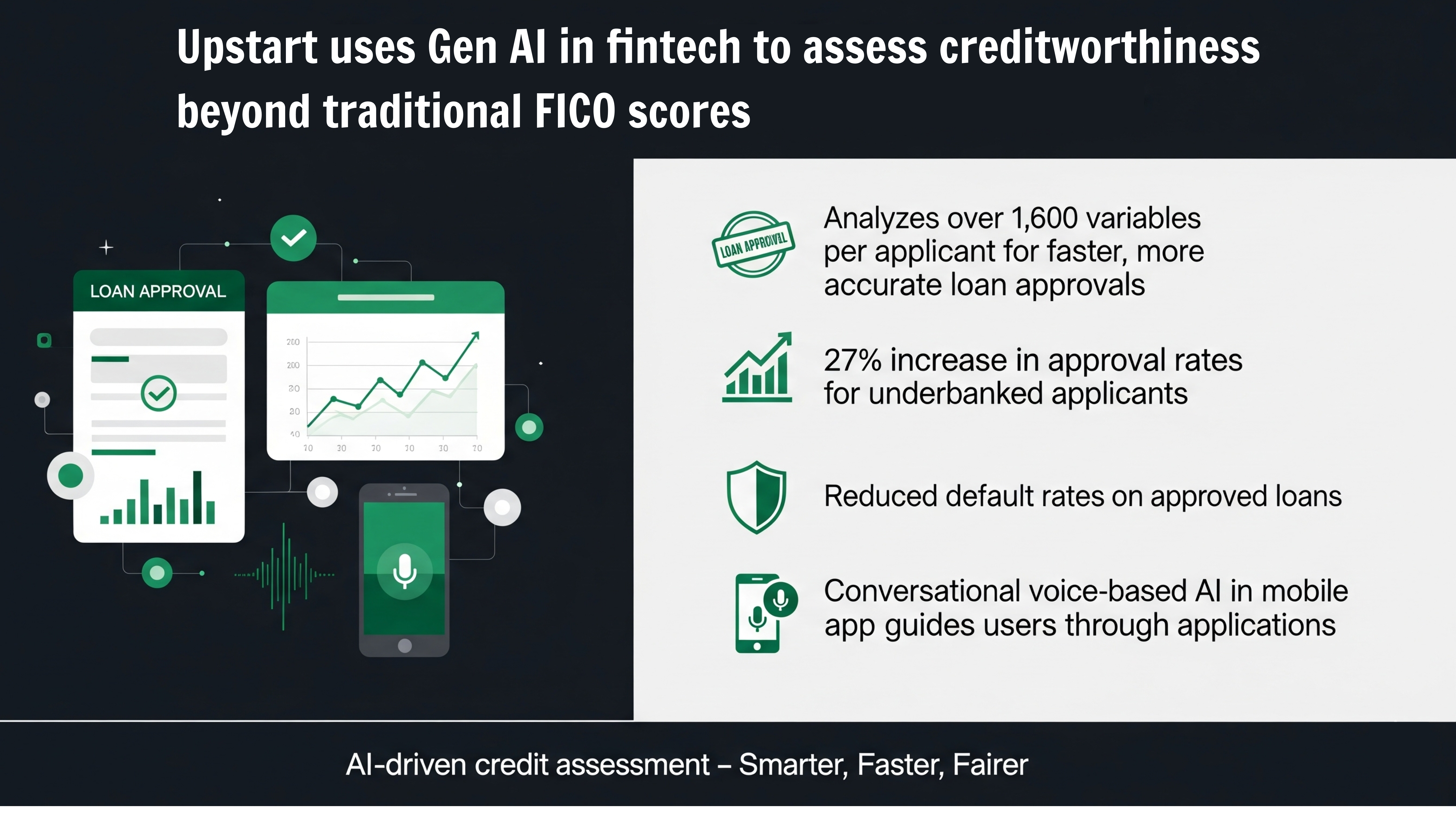
Upstart uses Gen AI in fintech to assess creditworthiness beyond traditional FICO scores. By analyzing over 1,600 variables per applicant, it approves loans faster and with more accuracy than conventional lenders. Their AI-driven approach has:
➥ Increased approval rates for underbanked applicants by 27%
➥ Reduced default rates for approved loans
➥ Leveraged conversational voice-based AI services in its mobile app to guide users through applications
5. Financial Education and Inclusion
➥ Gen AI in Fintech delivers personalized financial education, tailoring content to different literacy levels and demographics.
➥ By analyzing user data and behavior, it creates custom learning paths to enhance financial inclusion.
➥ Voice-based AI services enable users in rural or low-literacy regions to access banking tutorials, savings guidance, and credit awareness in their local language.
➥ This reduces the digital divide and improves financial literacy in underserved populations.
➥ Together, Gen AI in Fintech and voice-based AI services make microfinance, digital banking, and savings programs more understandable.
➤ Case Study
Paytm leveraged AI-driven chatbots and voice-based AI services to teach rural users about UPI payments, digital wallets, and savings tools. With the help of Gen AI in Fintech, the app provides localized tips and nudges, leading to millions of first-time users adopting digital payments and becoming part of the formal financial ecosystem.
6. Trading Algorithms and Market Forecasting
Trading in modern financial markets has been revolutionized by Gen AI in FinTech, enabling smarter, faster, and more adaptive strategies. Traditional algorithmic trading was based only on static rules, but with Generative AI models, predictive analysis, and natural language processing, institutions now analyze massive volumes of real-time financial data, market trends, and news sentiment to make predictive decisions.
➤ Case Study
Trading in modern financial markets has been revolutionized by Gen AI in FinTech, enabling smarter, faster, and more adaptive strategies. Traditional algorithmic trading was based only on static rules, but with Generative AI models, institutions now analyze massive volumes of real-time financial data, market trends, and news sentiment to make predictive decisions.
7. Regulatory Compliance and Reporting
Gen AI in FinTech is transforming compliance by making regulatory reporting smarter, faster, and more accurate. Instead of manual checks, AI-powered compliance tools analyze large financial datasets in real-time, ensuring institutions meet complex global regulations like KYC (Know Your Customer), AML (Anti-Money Laundering), and GDPR.
➤ Case Study
A leading European bank adopted Gen AI in FinTech for regulatory compliance. By integrating voice-based AI services for compliance officers, the bank reduced manual reporting errors by 40% and accelerated audit processes by 60%. The system flagged suspicious cross-border transactions in real-time, ensuring strict AML compliance while saving millions in fines.
Conclusion
The landscape of Fintech disruption in NYC is being reshaped by cutting-edge technologies, especially Gen AI in fintech and voice-based AI services. As AI innovations in New York finance accelerate, fintech startups and established institutions alike are leveraging machine learning, predictive analytics, and conversational AI to deliver smarter, faster, and more secure solutions. The convergence of Gen AI in fintech with voice-based AI services not only enhances customer engagement but also strengthens financial accessibility for diverse communities across NYC.
Ultimately, New York City’s fintech hub stands at the forefront of this digital revolution, setting benchmarks for the global finance industry. By embracing these transformative technologies, financial institutions in NYC are not just keeping pace; they are defining the future of finance.
FAQs
1. What is Gen AI in fintech, and why is it important?
Gen AI in fintech refers to the use of generative artificial intelligence to improve financial services. It is important because it enables faster decision-making, cost optimization, and hyper-personalized financial experiences.
2. Why is voice AI for customer support a growing trend in fintech?
Voice AI for customer support reduces call center costs, ensures 24/7 service availability, and provides instant query resolution.
3. What niches are being transformed by AI agents in finance?
AI agents are transforming niches such as wealth management, fraud detection, insurance underwriting, and regulatory compliance.
4. How can fintech firms leverage Gen AI and voice AI together?
By combining Gen AI in fintech with voice-based AI services, firms can create personalized, conversational financial assistants that not only analyze markets and predict risks but also interact naturally with customers through voice.