New York City has essentially flourished as a global epicenter for finance and technology integration. Both these concepts exist no longer in isolation but rather go hand-in-hand with each other. But as the famous saying in Spiderman goes, ‘With great power comes great responsibility’, the fortified fintech world comes with its fair share of complexities. From facing the constant and immense pressure to scale, compliance to stringent rules and regulations, and delivering an exceptional customer experience (CX), today’s fintech startups and financial institutions have upped the game. How? Through AI agents in fintech.
From accelerating credit scoring to simplifying compliance and delivering hyper-personalized customer experiences, AI-powered solutions for credit risk in fintech are solving these problems faster and smarter. In this comprehensive blog, we’ll explore the most impactful use cases of AI agents across the fintech landscape and how your company can adopt similar strategies.
We shall highlight:
✓ Real-world applications of fintech AI strategy
✓ Use of AI compliance tools to meet regulatory expectations
✓ Case studies delving into AI for customer experience transformation
✓ The impact of AI in credit scoring for underserved and overlooked populations
Let’s now understand how these myriad innovations are remodeling the financial ecosystem.
1. Intuitive Credit Scoring with AI Agents in Fintech
➣ The Challenge?
You may have keenly observed how individuals encompassed in a non-traditional earning bracket are often excluded from loan approvals. Lending criteria are narrow as many categories of people, ranging from gig workers, new immigrants, and younger applicants with scanty credit histories, often get rejected due to the absence of a sufficiently high CIBIL score. In dynamic markets such as NYC, this could create a huge bottleneck.
☑ The Solution
AI agents in fintech adopt the usage of alternative data to assess credit worthiness and provide AI-powered solutions for credit risk in fintech. They pull information from rental and utility payment history, open banking, transaction histories, and even behavioral patterns from financial apps. Using the combined power of machine learning and explainable AI, these agents have successfully managed to deliver swift, fair, and adaptive credit assessments.
☑ The Benefits of AI in Credit Scoring
Through the usage of AI agents automating underwriting processes, default rates have been lowered through predictive modeling. This has led to improved inclusion for non-traditional borrowers and real-time updates to creditworthiness.
☑ Case Study to Prove It
Upstart, a US-based lending platform, has emerged as one of the most prominent use cases for deploying AI in credit scoring to expand financial inclusion while minimizing default risk.
➣ The Problem:
Traditional credit scoring models like FICO depend heavily on a narrow band of variables, mainly credit history, income, and outstanding debt. This left out millions of potential borrowers, especially young adults or those with limited credit footprints (also known as “credit invisibles”). Banks relying solely on conventional scores faced two major challenges, namely high rejection rates for borrowers with no credit history and inaccurate risk assessments, leading to unexpected delinquencies.
☑ The AI-Powered Solution:
Upstart built a proprietary AI-powered credit risk model that analyzes over 1,600 data points per applicant, including:
1. Education level and field of study
2. Employment history and job trajectory
3. Cost of living by ZIP code
4. Banking transaction patterns
5. Digital footprint and alternative data
These data points were processed by AI agents in fintech using machine learning algorithms that were continuously trained on loan repayment behavior.
➤ Outcomes:
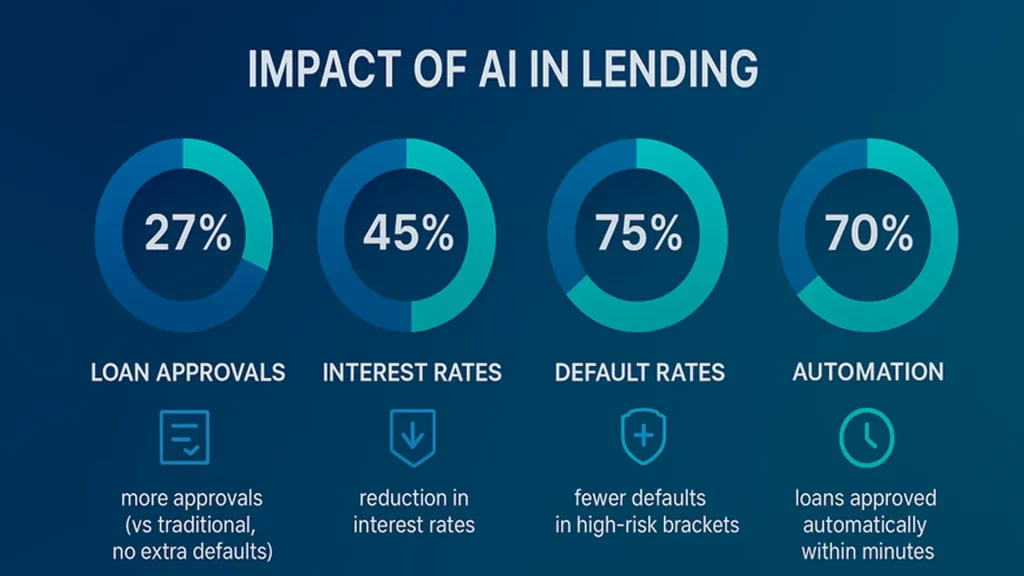
1. 27% more loan approvals compared to traditional models, with no increase in default rates.
2. 45% reduction in average interest rates for approved borrowers due to more accurate risk segmentation.
3. Bank partners using Upstart’s platform saw 75% fewer defaults within high-risk brackets after switching to the AI model.
4. Fast loan decisions, where 70% of loans were fully automated and approved within minutes without human involvement.
☑ Why It Worked:
1. The AI model provided explainable credit scoring backed by rigorous compliance checks, making it easier for regulators and bank partners to trust the outcomes.
2. By identifying “hidden prime” borrowers (those with good repayment potential but low traditional scores), AI agents in fintech widened access to fair credit.
3. Continual model updates ensured the system stayed accurate even during macroeconomic shifts (like COVID-19 volatility).
☑ Key Takeaways:
This is a standout example of how AI-powered solutions for credit risk in fintech not only improve accuracy but also unlock new markets, fulfilling both profitability and social responsibility. It shows the future of fintech AI strategy is not just about speed, but smarter decision-making at scale.
2. Automated Compliance with AI Compliance Tools
➣ The Challenge?
Fintech companies face insurmountable pressure to comply with evolving data protection, AML (anti-money laundering), and KYC (know your customer) laws. Manual compliance is fraught with errors and hefty expenses. Enter AI compliance tools, and they solve your problems.
☑ The Solution
AI agents in fintech have solved compliance challenges through automated transaction monitoring and anomaly detection, AI-powered document verification and fraud checks, and predictive compliance alerts based on regulatory updates. What once took 3 days through manual audits can now be done in 20 minutes through AI agents in fintech.
☑ Case Study
As Revolut rapidly expanded across regions, compliance demands grew exponentially. Traditional manual KYC and AML checks were becoming bottlenecks, causing delays in onboarding and increasing the risk of non-compliance across jurisdictions.
To solve this, Revolut integrated ComplyAdvantage, an AI-powered compliance tool that automates global sanctions screening, adverse media monitoring, and transaction anomaly detection.
☑ Implementation Details:
1. ComplyAdvantage’s AI agents screened users against real-time global watchlists.
2. The system used natural language processing to extract structured data from ID documents.
3. AI agents generated fully auditable logs, ensuring regulatory readiness for audits under GDPR, FinCEN, and NYDFS frameworks.
☑ Results:
1. 85% reduction in false positives, minimizing unnecessary case reviews.
2. 70% faster customer onboarding, enabling Revolut to onboard thousands of users daily.
3. Enhanced scalability where AI agents operated 24/7 without fatigue or errors.
4. Compliance costs dropped significantly due to automation of repetitive tasks.
☑ Why It Worked:
1. The AI agents were explainable, traceable, and monitored through agent-governance layers that ensured ethical and lawful decision-making.
2. Revolut’s engineering team spent less than 2 weeks integrating the tool via API. This demonstrated the plug-and-play advantage of modern fintech AI strategy.
3. Customer Experience (CX): Human-Like Agents with Machine Efficiency
➣ The Impact
We live in a digital-first world where customer relation is just as important as acquisition. AI agents in fintech are drastically revolutionizing how financial startups and institutions work with users. Well, how are startups improving customer experience in fintech with AI? Through:
➥ Chatbots and virtual agents that handle Level 1 and Level 2 queries
➥ Personalized product recommendations based on behavior and transaction history
➥ Multilingual support with NLP (natural language processing)
☑ The Results
Companies utilizing AI for customer experience have seen a 40% drop in churn and a 3x increase in app engagement.
☑ Case Study
Lemonade, a disruptive fintech startup, is a textbook example of how AI agents in fintech can revolutionize customer experience (CX), making it faster, more transparent, and deeply personalized.
➣ The Problem:
Traditional insurance models were bogged down with slow claims processing, long wait times, and low trust from customers. Users often described their experience as impersonal, bureaucratic, and frustrating.
➣ AI-Driven CX Strategy:
Lemonade embedded AI-powered chatbots—“Maya” for onboarding and “Jim” for claims processing—across its entire customer journey. These AI agents weren’t just scripted bots but dynamically trained NLP models that adapted over time.
➣ Key Features:
1. Maya onboarded users in under 2 minutes by asking natural questions and customizing policies on the fly.
2. Jim handled claims end-to-end, from verification to payout, using AI to assess the authenticity of a claim based on behavior, documentation, and risk profiling.
3. Integration with facial recognition and behavioral biometrics to detect fraud in real time.
☑ Outcomes:
1. 30% increase in customer satisfaction (CSAT) within six months of full AI rollout.
2. Claims settlement time reduced from 3 days to under 3 minutes in 40% of cases.
3. Customer churn decreased by 20% due to enhanced engagement and support accessibility.
4. AI for customer experience allowed Lemonade to scale support operations without hiring large human teams—creating cost savings and consistency.
☑ Why It Worked:
1. Lemonade’s AI agents aligned perfectly with customer expectations for instant, human-like interaction.
2. The CX journey was driven by data, allowing for hyper-personalized recommendations, faster responses, and proactive issue resolution.
3. By blending fintech AI strategy with behavioral science, Lemonade turned a cold process into a warm, digital experience.
Fintech AI Applications in NYC and Beyond
Fintech innovation is spreading globally, but fintech AI applications in NYC showcase how urban financial hubs are leveraging tech for better governance and CX. Besides, NYC is where it all began, the heart of fintech emergence.
Examples from NYC fintech scene include:
➥ NYC fintech compliance tools helping firms meet complex U.S regulatory standards
➥ AI-driven loan underwriting for underserved NYC populations
➥ Local startups using fintech AI strategy for hyper-targeting services
Why AI Agents in Fintech are the Future
The adoption of AI agents in fintech is not just a trend but rather a necessity that’s a result of changing times. These agents help firms:
➥ Scale operations without bloating teams
➥ Maintain flexibility in a rapidly regulating world
➥ Offer hyper-personalized services that drive loyalty
Whether you’re a founder, CTO, or compliance officer, integrating AI compliance tools, AI scoring models, and smart CX agents should be central to your fintech AI strategy.
Conclusion: From Risk to Rewards with AI agents
The future of fintech is autonomous, intelligent, and agile. Companies that strategically invest in AI agents in fintech today will gain the upper hand in tomorrow’s competitive market.
Start by identifying which AI-powered processes can eliminate bottlenecks in your current system, be it how AI agents help solve compliance and CX issues or through credit scoring. And remember, whether you’re operating in a global market or focusing on fintech AI applications in NYC, the right fintech AI strategy can determine your growth trajectory.
FAQs
1. How are AI agents used in fintech today?
AI agents in fintech are used to automate and simplify processes such as credit scoring, regulatory compliance, fraud detection, and improving customer experience.
2. Is AI adoption expensive for small fintech startups?
While initial setup can be resource-intensive, many AI agents in fintech are available through scalable cloud platforms or as plug-and-play APIs. These solutions can be cost-effective over time.
3. What makes AI agents better than traditional fintech solutions?
Unlike rule-based systems, AI agents in fintech can learn from data patterns and adapt to changing circumstances. They can process large amounts of data and generate insights much better than humans.
4. Can AI improve customer experience in fintech?
Yes. AI for customer experience in fintech personalizes services, automates support through AI-powered chatbots, and offers real-time solutions to customer queries, reducing response times, improving satisfaction scores, and enhancing loyalty.