Step into today’s advancing financial ecosystems, and you’ll be surprised at how tasks that once seemed arduous and cumbersome have become a piece of cake. The current era is digital-first, and two innovations have particularly stood out, namely ‘Agentic AI in Fintech’ and ‘Custom Fintech Chatbots’. No longer just buzzwords, these intelligent solutions are actively shaping customer experiences, risk management, compliance, and operations within the finance sector.
With the surge in demand for Conversational AI in Fintech, more firms are embracing Fintech transformation with AI powered banking chatbots to remain competitive. This blog shall delve into varied topics like:
☑ Fintech-associated problems
☑ How Agentic AI and Custom Fintech chatbots solve these issues
☑ Real-world case studies
A Life Without Agentic AI in Fintech: The Gaping Holes
Finding the reason behind the buzz of custom fintech chatbots lies in accounting for the root causes and problems that are prevalent in today’s fintech world. Here are some:
1. Customer Support Burnout and Cost Overruns
Fintech platforms are expected to cater to customers needing clarification 24/7. This can be extremely cumbersome, with increasing expenses of traditional call centers, slow processing, and the risk of human error.
Response times through manual operators lead to inconsistency, leading to customer churn.
According to a Zendesk study, 67% of customers expect support around the clock. Traditional call centers require large teams, resulting in escalating costs and slow response times.
✔ Without custom fintech chatbots, scaling support without sacrificing quality is nearly impossible.
2. Limited Personalization and Low Customer Retention
A McKinsey report stated that personalization can drive a 5-15% increase in revenue and boost retention rates by 10-30%. Yet many fintech platforms rely solely on generic messaging.
Generic notifications and mass-targeted financial products fail to resonate with users. Without tailored engagement, customers, left feeling disconnected and undervalued, are more likely to switch to competitors offering personalized services.
✔ Without agentic AI in fintech to analyze transaction histories and predict needs, personalization remains shallow, pushing users toward competitors.
3. Outdated Fraud Detection Systems
Did you know that in 2023 alone, digital banking fraud cost the industry $5.8 billion globally (according to Statista)?
Well, this staggering amount is tantamount to how legacy systems, dependent on static rules, have struggled to detect emerging threats and adapt in real time.
The occurrence of false positives have continually frustrated genuine customers, while slow alerts give fraudsters the upper hand.
✔ Agentic AI enabling smarter Fintech operations can address this gap by continuously learning from evolving fraud patterns and instantly engaging customers via conversational AI in fintech.
4. Complex and Costly Compliance Processes
Compliance management is one of the top three budget drains in financial institutions. Regulatory changes occur frequently, and manual checks increase the risk of errors, leading to penalties.
In the U.S alone, some banks spend up to 10% of their operating budget on compliance alone.
✔ Without the role of custom chatbots in financial services for automation, staying compliant in real time is truly costly and labor-intensive.
5. Inefficient Product Discovery and Conversion Bottlenecks
Research shows that 74% of customers abandon online financial product applications due to complex processes or irrelevant offerings.
Without guided assistance, one could imagine customers’ plight when the right products for their needs are not found.
✔ Custom fintech chatbots integrated with fintech transformation with AI powered banking chatbots can guide customers step-by-step, boosting engagement and improving conversion rates.
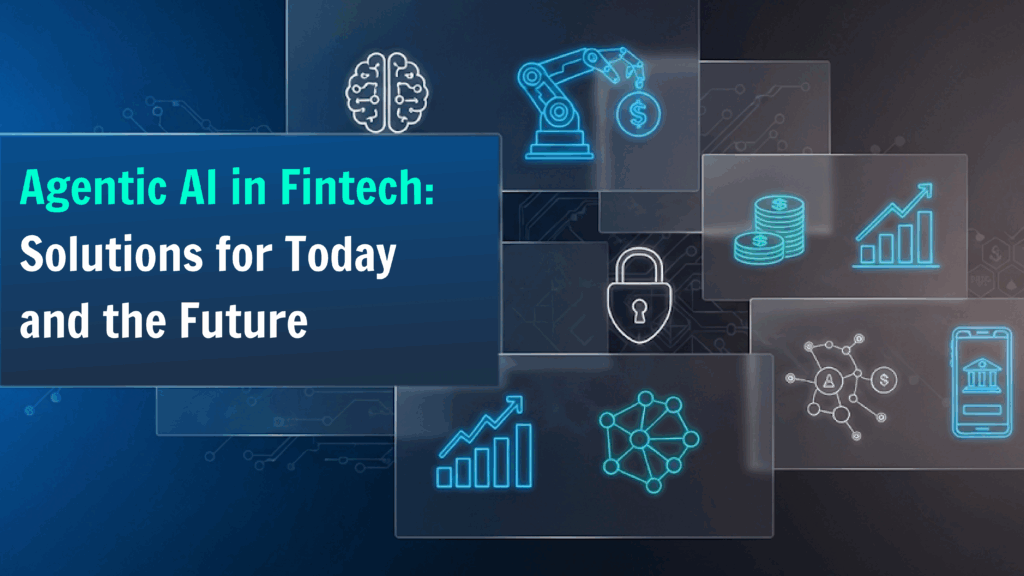
Agentic AI in Fintech: Solutions for Today and the Future
Without agentic AI in fintech and custom fintech chatbots, startups evidently face persistent roadblocks, right from customer support burnout to outdated fraud detection. Below are some ways how these intelligent, self-directed AI systems are revolutionizing the world of Fintech today and will continue to shape the future.
1. Overcoming Customer Support Burnout and Cost Overruns
As seen in the previous section, traditional fintech customer service models involve human agents handling repetitive tasks such as balance inquiries, transaction disputes, and loan status checks, ultimately leading to burnout but also escalating operational costs.
Agentic AI in fintech transforms the scenario by deploying autonomous context-aware AI agents that can handle up to 80% of Tier-1 queries without human intervention.
➥ Today’s Impact?
Custom fintech chatbots offer real-time 24/7 multilingual support, instantly reducing wait times and eliminating fatigue-related errors.
➥ Future Outlook?
With self-learning capabilities, these systems will proactively resolve issues before customers even ask, for example, detecting an unusual account charge and initiating a resolution workflow automatically.
Thus, by integrating conversational AI in fintech, companies reduce costs by up to 30% annually, through improvement of first-contact resolution and keeping agentic AI-enabled chatbots at the core of the service experience.
2. Unlocking the Key to Personalization
Agentic AI in fintech enables hyper-personalization at scale by continuously analyzing transaction histories, spending patterns, and customer preferences.
➥ Today’s Impact?
Custom fintech chatbots can recommend investment plans, savings goals, or loan options that align with each customer’s unique profile.
➥ Future Outlook?
AI agents will use predictive analytics to anticipate future needs. This could mean suggesting mortgage refinancing when interest rates drop or offering micro-investment opportunities based on spare account balances.
Overall, fintech transformation with AI powered banking chatbots drives higher retention by delivering contextual, relevant, and timely interactions, turning casual users into long-term loyal customers.
3. The Touch of Modernization in Fraud Detection
Agentic AI in fintech leverages adaptive machine learning models that continuously learn from evolving fraud patterns, catching even the most subtle and sophisticated threats.
➥ Today’s Impact?
Custom Fintech chatbots integrated with fraud engines can instantly flag suspicious activities, lock compromised accounts, and notify customers in real time.
➥ Future Outlook?
AI agents will collaborate across banking networks, using federated learning to share anonymized fraud intelligence, allowing institutions to stop fraud attempts globally within milliseconds.
Conversational AI in Fintech ensures seamless fraud resolution by blending real-time detection with a humanized notification process, keeping customers informed and protected.
4. Streamlining Compliance Processes
Regulatory compliance in financial services is time-consuming and expensive, with constant changes across jurisdictions.
Agentic AI in Fintech can automate up to 70% of compliance-related tasks, including KYC (Know Your Customer) checks, AML (Anti-Money Laundering) screening, and report generation.
➥ Today’s Impact?
Custom Fintech chatbots guide customers through compliance processes, validating IDs, and cross-referencing data against watchlists, all without human error.
➥ Future Outlook?
AI agents will self-update compliance workflows when regulations change, ensuring institutions remain compliant without costly overhauls.
This approach not only cuts costs but also minimizes legal risks, making Agentic AI enabling smarter Fintech operations a critical driver of sustainable growth.
5. Improving Product Discovery through Agentic AI in Fintech
Many customers abandon applications for loans, credit cards, or investment products due to confusing forms or poor guidance.
Agentic AI in Fintech offers intuitive, conversational product discovery, guiding customers through application processes step-by-step.
➥ Today’s Impact?
Custom Fintech chatbots can qualify leads in real time, present relevant products, and assist in completing the purchase or application.
➥ Future Outlook?
AI will use real-time sentiment analysis to detect hesitation and counter it with tailored offers or simplified terms, boosting conversion rates by 25–40%.
By addressing chatbot use cases in modern banking, institutions can reduce drop-offs, speed up onboarding, and deliver a frictionless journey from interest to acquisition.
A Local Perspective: Fintech Transformation in New York
For innovation hubs like New York, the nudge towards fintech transformation in New York is accelerated by the high demand for custom chatbots in financial services and AI-powered banking solutions. Startups and established banks alike are tapping into agentic AI to deliver hyper-personalized, compliant, and efficient services that match the fast-paced lifestyle of NYC’s financial ecosystem.
Conclusion: Custom Fintech Chatbots All the Way Ahead!
The future of agentic AI in fintech is the reality that is making waves in the fintech world, reshaping how financial institutions serve, protect, and retain customers. Custom fintech chatbots are at the core of this transformation. These AI-powered solutions don’t just solve today’s pain points but proactively anticipate future needs. The combination of agentic AI in fintech and customized financial chatbots is truly redefining the standard for conversational AI in fintech.
Businesses that adopt fintech transformation with AI powered banking chatbots are not only staying competitive but setting the stage for standards and industry benchmarks. As regulations tighten, customer expectations rise, and fraudsters evolve, agentic AI enabling smarter fintech operations will become the decisive advantage.
The path forward is clear:
☑ Invest in custom fintech chatbots
☑ Embrace full potential of agentic AI in fintech
☑ Prioritize customer trust, personalization, and security
Those who act now won’t just adapt to the future but will surely define it and all the boundaries imaginable in the world of fintech.
FAQs
1. What is agentic AI in fintech and how does it work?
Agentic AI in fintech refers to advanced artificial intelligence systems capable of making autonomous decisions, learning from past interactions, and proactively improving financial processes. Unlike traditional chatbots, AI-powered banking chatbots can handle vast complexities and workflows.
2. How can custom fintech chatbots improve customer support in financial services?
Custom fintech chatbots reduce customer support burnout by automating high-volume queries, resolving issues instantly, and escalating only complex cases to human agents.
3. Are AI-powered banking chatbots secure for handling sensitive financial data?
Yes. Leading AI-powered banking chatbots integrate real-time fraud detection systems, end-to-end encryption, and regulatory compliance frameworks (like GDPR, PCI DSS, and SOC).
4. Are custom fintech chatbots cost-effective for budding fintech startups?
Yes. They can drastically cut operational expenses by automating repetitive support tasks, streamlining onboarding, and reducing fraud-related losses.