Most Canadian businesses are already using generative AI in some form. A writing assistant here. A chatbot there. Someone on the team is using ChatGPT to draft emails. That’s useful, but it still requires a person to sit in the middle of every task, reviewing, deciding, and acting.
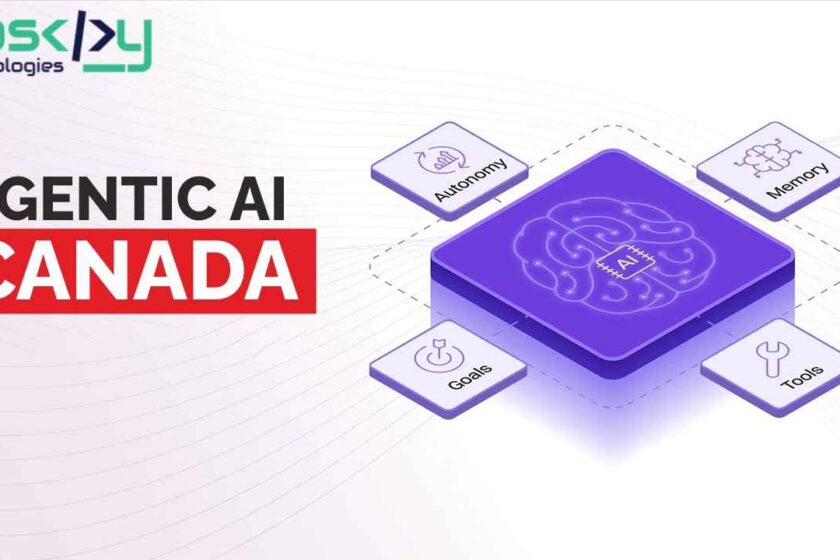
Agentic AI removes that bottleneck. It doesn’t just generate a response. It plans steps, uses tools, checks progress, and completes tasks on its own, without a human steering every move.
Only 27% of Canadians are currently familiar with agentic AI Service, despite nearly 70% recognising generative tools like ChatGPT. That gap won’t last long. Naskay helps Canadian businesses close it before it becomes a competitive problem.
What makes agentic AI different from tools you’re already using?
Generative AI responds to prompts. You type, it replies. Useful, but passive. Agentic AI operates differently. It receives a goal, builds a plan, executes steps across multiple systems, and adjusts when something changes mid-task.
Think of it this way. A generative tool helps you write a supplier escalation email. An agentic system notices the delivery is overdue, checks the supplier record, drafts the escalation, logs it in your CRM, and marks the purchase order for review. Nobody typed a prompt. The system handled it.
This is why agentic AI is scaling faster than most enterprise technology categories right now. It doesn’t just augment human work; it completes defined tasks independently.
What agentic AI can do that a chatbot can’t
A chatbot answers questions within a single conversation. An AI agent acts across systems, keeping track of the goal and adapting as the situation changes. For businesses managing multi-step workflows, that difference is significant.
Why goal-setting replaces prompt-writing
With agentic systems, you define the objective, not the individual steps. The agent figures out the sequence. This shifts the interaction model from “tell it what to write” to “tell it what to achieve,” which scales much further across a team.
How a Generative AI solution fits alongside agents
Most practical agentic builds include a generative AI solution as one component. The agent might use generative capabilities to draft an output, then use other tools to act on it. Naskay designs both layers together so they work as a coherent system, not separate experiments.
Where Canadian businesses are using agents right now
Agentic AI is already active in Canadian financial services, healthcare coordination, logistics operations, and customer service. TD Bank acquired Layer 6 AI, which uses deep learning agents for personalised customer experiences. These aren’t niche applications. They’re operational systems managing real volume.
What does Naskay build for Canadian businesses?
Naskay designs and builds AI agent systems tailored to specific operational problems. Not a platform with pre-set agents. Custom-built systems that connect to your data, your tools, and your workflows.
The starting point is always the same: which task in your operation currently requires the most human coordination to complete? That’s where an agentic build produces the fastest, most measurable result.
Customer service and resolution agents
Agents that handle inbound queries end-to-end, checking order history, processing returns, updating accounts, and escalating to a human only when the situation genuinely requires it. These go well beyond scripted chatbots and handle contextual, multi-step service scenarios.
Back-office workflow automation agents
Invoice matching, procurement approvals, compliance checks, and HR document processing. Naskay builds agents that move work through your back office without manual handoffs. A single agent can pull from three systems, make a conditional decision, and route the outcome automatically.
Sales and lead management agents
Agents that monitor inbound leads, enrich CRM records from public sources, score leads against defined criteria, send personalised follow-up sequences, and alert the sales team when a prospect’s behaviour signals buying intent. The sales team focuses on conversations, not data entry.
Research and analysis agents
For legal, consulting, financial, and engineering firms, research is expensive and time-consuming. Naskay builds agents that gather, summarise, cross-reference, and structure research outputs from defined source sets. The analyst reviews, not retrieves.
Why does the compliance and governance layer matter in Canada?
Canada’s AI regulatory environment is moving. Bill C-27, the Artificial Intelligence and Data Act (AIDA), proposes obligations for high-impact AI systems, including transparency, human oversight, and risk management requirements. Agentic systems, because they act autonomously, fall squarely into the category that regulators are watching most closely.
Naskay builds agent systems with governance built in, not added as an afterthought. Every agent has defined boundaries: which tools it can use, which data it can access, which actions require human confirmation before execution, and how its decisions are logged for audit purposes.
For Canadian businesses in regulated sectors, that architecture isn’t optional. A Generative AI solution component within an agentic system still needs to be explainable, auditable, and bounded in scope.
Human-in-the-loop controls
Every Naskay agent build includes defined escalation points where human confirmation is required before irreversible actions are taken. Sending a refund, cancelling a contract, changing account status. The agent prepares and recommends; a human confirms.
Audit trails for regulated industries
Financial services and healthcare operations in Canada require records of automated decisions. Naskay builds logging into the agent pipeline so every decision, action, and escalation is traceable. This satisfies compliance requirements and makes it straightforward to investigate any unexpected outcome.
Data residency and privacy controls
Canadian businesses handling personal information under PIPEDA need to know where that data goes when an agent processes it. Naskay builds with Canadian data residency in mind, ensuring agent pipelines don’t send personal data outside defined boundaries.
Scalable governance as the agent scope expands
Most businesses start with one agent. They quickly want to add more. Naskay designs governance frameworks that scale: access controls, audit architecture, and escalation policies that hold up as more agents are added to the environment.
How does the build process work?
Naskay starts with a discovery session focused on one specific workflow. Not a roadmap, not a strategy document. A single operational process that costs time, creates errors, or requires too many handoffs. That becomes the first agent scope.
From there, Naskay designs the agent architecture: which tools the agent connects to, which decisions it makes autonomously, where it defers to a human, and how its performance will be measured. The scope is fixed before the build begins.
Delivery is phased. A working agent goes live in a controlled environment first, handling real tasks under observation. Issues that wouldn’t have been visible in testing surface during this phase, and the system is adjusted before full deployment.
Post-launch, Naskay monitors agent performance, tracks task completion rates, and handles changes when connected systems or processes change. An agent that isn’t maintained drifts. Naskay treats ongoing support as part of the engagement, not a separate conversation.
The Generative AI solution layer, where it’s part of the agent’s capability, is also monitored for output quality and updated when the underlying model or knowledge base changes.
Canada’s agentic AI adoption is early, but it’s accelerating. The businesses that build working agent systems now will have a head start that’s difficult to close later. Book a discovery session with Naskay and bring the workflow that’s costing the most time. That’s the right place to start.