Step into any hospital today, and you’ll notice a quiet revolution. Walls once painted in dull whites are now soothing tones of mint green or sky blue. Patient rooms glow with ambient warmth instead of fluorescent harshness. But this transformation isn’t just aesthetic. It’s strategic, powered by AI insights and color psychology.
In 2025, healthcare design has become a science of empathy, where technology, psychology, and user experience merge to create spaces that heal as much as they treat. With generative AI in healthcare shaping everything from architectural layouts to digital interfaces, and with color psychology charts guiding emotional impact, hospitals are evolving into intelligent ecosystems that respond to human behavior in real time. This has exemplified data-driven empathy, redefining healthcare forever.
Why 2025 Marks a Turning Point in Healthcare Design
The healthcare industry has finally realized that healing doesn’t happen in isolation; it happens within environments. Clinical spaces influence patient outcomes just as much as medical procedures do. That’s why 2025 is a defining year for healthcare design, because it’s no longer driven by architecture alone, but by algorithms.
AI can now analyze how patients emotionally react to different environments, color schemes, and digital touchpoints. For example:
▪ A patient recovering from surgery may find lower stress levels in cool blue surroundings.
▪ A pediatric ward might use brighter colors to reduce anxiety and promote playfulness.
These insights, pulled from color psychology charts and behavioral data, are helping designers create spaces that balance emotional and physical healing. Generative AI in healthcare can simulate these effects even before construction begins, predicting outcomes, visualizing comfort, and optimizing layouts for maximum well-being.
The Power of Color Psychology in Healing Spaces
Color has always been emotional, but in healthcare design, it’s now scientific. Every hue triggers a psychological and physiological response:
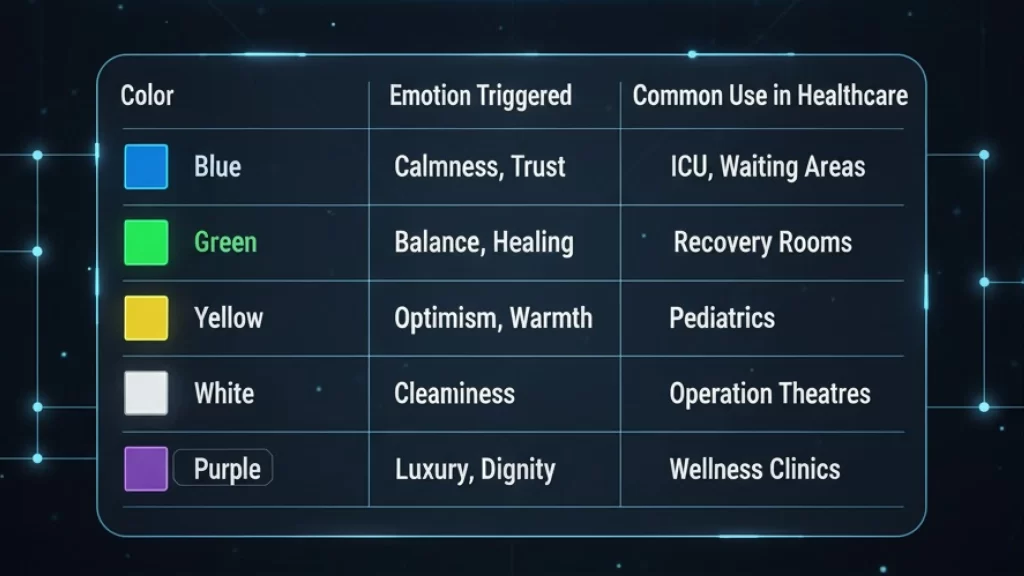
This color psychology chart has become the blueprint for modern Healthcare UX and architectural design alike. When AI systems interpret this data, they don’t just suggest colors randomly. They analyze thousands of patient reactions, such as heart rate changes, comfort feedback, even recovery times, to find the shades that support healing. So when you feel unusually relaxed in a certain hospital, remember: it’s not coincidence. It’s calculated compassion.
How Generative AI in Healthcare Is Transforming Design Strategy
Gone are the days of guesswork. With generative AI in healthcare, designers can now train algorithms to model patient behavior, simulate mood responses, and even predict how environmental elements affect recovery. Here’s how it works:
1. Data Collection: AI gathers data from sensors, surveys, and health apps on how patients feel in certain spaces.
2. Design Simulation: Generative models test different lighting, textures, and color combinations virtually.
3. Predictive Output: The AI recommends the best healthcare design variations for comfort and emotional balance.
Think of it as a creative collaborator or an AI that co-designs with architects and psychologists. One real-world example? Some smart hospitals in Singapore and Sweden already use AI-generated Healthcare UX models to redesign wards based on patient anxiety levels.
When combined with color psychology charts, these models reveal which tones reduce fear and which energize recovery. It’s precision design, guided by empathy, powered by intelligence.
Healthcare UX: Where Design Meets Digital Empathy
Healthcare design in 2025 isn’t confined to walls. It extends to screens, dashboards, and patient portals. That’s where Healthcare UX comes in. A telemedicine app, for example, isn’t just a platform but rather an emotional experience.
A calming background color, a friendly interface tone, and intuitive navigation can drastically reduce patient hesitation and improve compliance. AI tools now help designers test color psychology in digital healthcare UX. For instance:
▪ A soft gradient of green during teleconsultations can help reduce perceived stress.
▪ Warmer tones in appointment confirmations can subtly convey empathy and reassurance.
Through generative AI in healthcare, UX designers can simulate emotional responses to various designs before final deployment. In short, healthcare design is now as much about emotional architecture as it is about physical structure.
The Role of Color Psychology in Improving Patient Outcomes
The role of color psychology in improving patient outcomes is not theoretical anymore; it’s backed by measurable results.
Research shows that:
➥ Patients in rooms with nature-inspired hues report 22% lower anxiety.
➥ Pediatric patients surrounded by colorful, playful designs need less sedation before procedures.
➥ Staff in ergonomically and aesthetically balanced workspaces experience higher focus and lower burnout rates.
In other words, well-planned healthcare design isn’t just good for patients. It’s good for caregivers too. AI systems now track these outcomes in real time, allowing continuous optimization of environments. Hospitals are becoming “emotionally intelligent,” using color psychology charts and predictive AI to fine-tune surroundings based on ongoing feedback.
Healthcare Design Trends Influenced by AI in 2025
Let’s talk about the trends leading this shift- the ones shaping the very future of healthcare design in 2025.
1. Adaptive Color Environments – Lighting and wall hues adjust dynamically based on time of day or patient mood.
2. AI-Assisted Architecture – Generative AI in healthcare helps architects design optimal layouts for flow, hygiene, and comfort.
3. Emotion-Aware Digital Interfaces – Healthcare UX systems analyze patient micro-behaviors to modify app visuals for better engagement.
4. Biophilic AI Design – Integration of natural tones and AI-generated nature-inspired visuals to simulate outdoor serenity.
5. Color as a Treatment Tool – Designers and psychologists working together to deploy chromotherapy techniques backed by AI metrics.
These healthcare design trends influenced by AI in 2025 underline a single truth, that healing starts with how a patient feels, not just how they’re treated.
Benefits of Using Color Psychology in Healthcare Spaces
Let’s simplify what this all means. The benefits of using color psychology in healthcare spaces go far beyond looks:
1. Faster Healing: Patients exposed to calming tones show quicker recovery rates.
2. Reduced Anxiety: Strategic colors minimize cortisol levels and tension.
3. Enhanced Focus for Staff: Balanced environments improve alertness and job satisfaction.
4. Higher Patient Retention: Patients are more likely to return to clinics that “feel right.”
5. Better Brand Identity: Modern Healthcare UX backed by color psychology builds stronger emotional trust.
Combine this with generative AI in healthcare, and these benefits multiply, because now, design choices evolve automatically based on patient emotion data.
It’s healthcare that thinks before it heals.
The Future of Healthcare Design: Emotion Meets Intelligence
Imagine walking into a hospital that senses your anxiety and instantly adjusts its ambient colors.
Or a telehealth dashboard that changes hue to comfort you during a stressful diagnosis.
That’s not science fiction; it’s the direction healthcare design is headed.
The future is emotion-responsive healthcare- adaptive, intelligent, and deeply human. With generative AI in healthcare leading the charge and color psychology charts guiding emotion-driven choices, 2025 is the dawn of empathetic design intelligence.
This is where art meets data, and healing becomes holistic.
Conclusion: Designing the Future of Care
The greatest hospitals of the future won’t only be efficient. They’ll be emotionally aware. Healthcare design in 2025 is rewriting how we think about healing spaces, moving from sterile to sensory, from mechanical to meaningful.
By combining Healthcare UX, AI in healthcare, and color psychology, we’re shaping a new kind of care environment, namely one that listens, feels, and responds. Because design in healthcare isn’t about looking good; it’s about making people feel good. And AI just gives us the tools to finally measure and master that.
FAQs
1. How AI is transforming healthcare design in 2025?
AI helps designers predict patient emotions and design responsive environments. It’s changing how hospitals and digital platforms deliver comfort and efficiency in healthcare design.
2. What are the healthcare design trends influenced by AI in 2025?
Trends include adaptive lighting, biophilic AI visuals, and emotionally responsive Healthcare UX powered by generative AI.
3. What’s the role of color psychology in improving patient outcomes?
Colors affect stress, recovery, and comfort. By using color psychology charts, designers can select shades that enhance healing and emotional balance.
4. What are the benefits of using color psychology in healthcare spaces?
Better recovery rates, improved staff focus, and stronger emotional connection between patient and environment- all through strategic color design.
5. How does generative AI in healthcare help designers?
It allows simulation of design outcomes, helping predict how patients will feel in a space before it’s built, leading to smarter, more human healthcare design decisions.