The fintech space has never been noisier. Every fintech startup is racing to capture user attention, simplify money movement, and outsmart traditional banks. But in 2025, it’s no longer about who has the flashiest app; it’s about who listens to their customers the smartest way possible.
That’s where AI agent strategies, AI customer service, and voice-powered chatbot customer service step in to redefine fintech success. If you’re a fintech startup building for scalability, personalization, and retention, this is your wake-up call: you can’t survive 2025 without a solid AI agent strategy and a plan for voice-powered automation. Let’s decode why.
The Fintech Startup Dilemma: Innovation Without Connection
Here’s the irony: most fintech startups are built on brilliant ideas, yet many crumble because of poor customer engagement. Users want instant answers, contextual insights, and emotional intelligence, not endless “please hold” loops or cold text replies.
In short: innovation means nothing if users feel unheard.
That’s why the next big fintech wave isn’t just digital transformation, it’s AI-powered communication, all through AI customer service, chatbot customer service, and conversational agents that make users feel human again.
The fintech startup that nails this balance between automation and empathy wins the decade.
The AI Agent Strategy: Your Startup’s New Growth Engine
So what exactly is an AI agent strategy, and why is every fintech startup suddenly obsessed with it. Think of an AI agent as your startup’s digital workforce: intelligent systems that handle everything from customer queries to fraud detection to proactive financial suggestions.
Creating an AI agent strategy for fintech startups means structuring how AI integrates across your support, marketing, and customer experience layers. Here’s what a strong AI agent strategy includes:
▪ AI customer service that resolves 80% of routine queries instantly.
▪ Voice-powered chatbots that handle payments, KYC verification, and support queries hands-free.
▪ Data-driven learning where each interaction makes the AI smarter and more contextually aware.
In other words, your AI agent strategy turns fintech chaos into intelligent, scalable growth.
Why Voice Is the Missing Link in Fintech CX
Let’s face it- chatbots are powerful, but voice is personal. A text response might solve a problem, but a voice AI response builds connection. In 2025, voice-powered customer support is where AI customer service truly comes alive.
Imagine this: A user calls your app’s hotline, and instead of a robotic IVR menu, they get an intelligent voice AI that says:
“Hey Alex, I noticed your credit card limit is nearing max. Would you like me to increase it by ₹20,000 temporarily?”
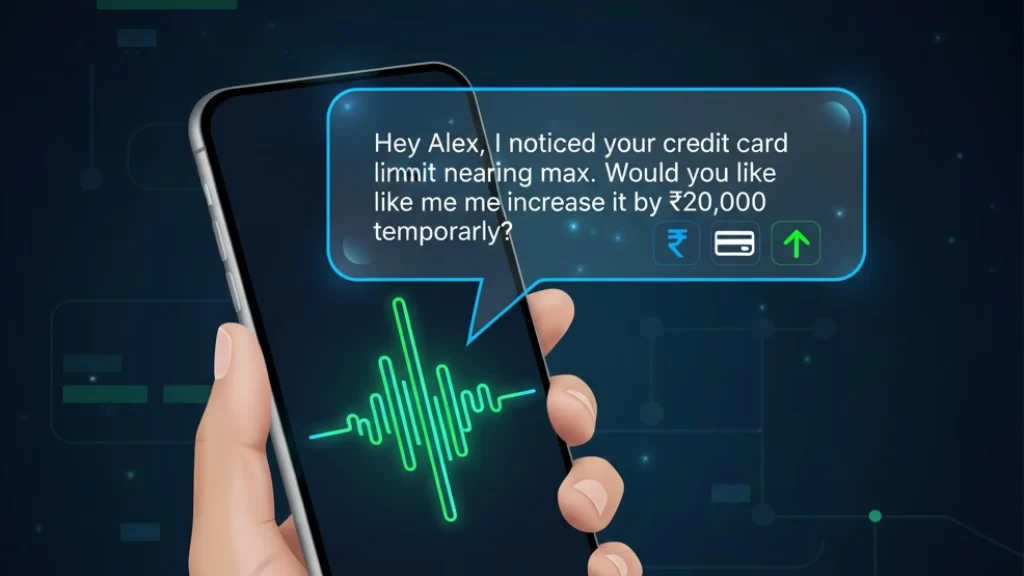
That’s AI customer service with personality, context, and timing: the trifecta of modern fintech. How voice AI boosts customer satisfaction is simple: it feels human, even when it’s not. And that’s exactly what today’s fast-paced, trust-hungry fintech audience craves.
Chatbot Customer Service: The Silent Revenue Multiplier
Let’s talk chatbot customer service because the silent chat window on your app could be your biggest profit driver. Chatbot customer service in fintech has matured beyond FAQs. Modern bots now:
➣ Handle transaction disputes in real-time
➣ Provide tailored financial advice
➣ Cross-sell insurance or loan products intelligently
➣ Alert users about suspicious account activity
Every fintech startup deploying chatbot systems with AI customer service integration sees an immediate drop in support costs and a sharp increase in retention. And here’s the real kicker: chatbots are becoming multi-modal. They don’t just chat; they talk, listen, and even sense frustration through tone analysis. This means your next fintech startup customer service agent might not just type; it’ll talk back.
AI Customer Service: Turning Cost Centers into Profit Engines
Customer service used to be a cost center. Now, with AI customer service, it’s a growth engine. By embedding AI across your fintech user journey, you turn every conversation into an opportunity.
Think:
➣ Predicting when a user might need a credit top-up.
➣ Proactively flagging risky transactions.
➣ Auto-summarizing chat logs for compliance audits.
That’s not just efficiency; that’s intelligence in motion. The key difference in 2025?
AI customer service isn’t reactive anymore. It’s predictive, voice-activated, and hyper-personalized.
Creating an AI Agent Strategy for Fintech Startups
Let’s get practical; how do you actually start building an AI agent strategy as a fintech startup?
Here’s the Naskay-style blueprint:
1. Map Your Pain Points: Where are you losing time, money, or users? That’s your first AI target.
2. Start Small, Scale Smart: Begin with a single chatbot customer service use case like onboarding or support.
3. Integrate Voice Early: Voice assistants build trust faster; add them as soon as possible.
4. Feed It Data: The richer your financial data, the smarter your AI agents become.
5. Test, Train, and Iterate: Treat your AI like a team member- train it, review it, and let it evolve.
With this roadmap, your fintech startup won’t just automate tasks; it will build an intelligent communication ecosystem that grows with every user.

The 2025 Trends in AI-Driven Support Systems
Let’s peek into the future: the 2025 trends in AI-driven support systems are reshaping fintech from the inside out. Here’s what you can expect:
➥ Voice-first Fintech Apps: Where talking to your app replaces typing.
➥ Agentic AI: Systems that take initiative without being prompted.
➥ Emotion-Aware Bots: Detecting tone, stress, or frustration and responding empathetically.
➥ Autonomous Compliance: AI systems automatically ensuring transactions meet regulatory standards.
➥ Integrated AI Dashboards: Real-time analytics that help startups track customer sentiment and service gaps.
Your AI customer service in 2025 won’t just support customers; it’ll understand them before they even reach out.
The Trust Equation: Why Fintech Startups Must Get Human Again
Money is emotional. That’s the secret every great fintech startup understands. People don’t just want faster apps; they want safer, smarter, more humanized experiences. That’s why trust is the new metric for fintech success. When your users can talk to a voice AI that sounds empathetic, or chat with a bot that remembers their history, they feel valued. That’s the magic of combining AI customer service and chatbot customer service into one holistic experience. It turns customer support into customer confidence.
Naskay’s Take: Strategy Beats Experimentation – Always
Let’s be blunt. Too many fintech startups are still “experimenting” with AI like it’s 2018. They roll out generic chatbots that can’t evolve, or patchwork voice systems that fail to connect emotionally. That’s not innovation; that’s digital clutter.
At Naskay, we believe in designing AI ecosystems that learn, adapt, and scale. A well-implemented AI agent strategy transforms your startup from a reactive support model into a proactive service engine. When technology feels human and anticipates needs, trust turns into loyalty, and loyalty into lifetime value.
Conclusion: Fintech Startups That Listen Will Lead
2025 will be remembered as the year when fintech startups either evolved with AI, or got left behind. The era of static chatbots and scripted responses is over. The winners are already embedding AI customer service, voice AI, and chatbot customer service at the heart of their brand experience.
If you’re a fintech startup aiming to stand out, this is your move:
➥ Build your AI agent strategy around empathy and intelligence.
➥ Prioritize voice-powered automation to make users feel heard.
➥ Keep evolving because AI that doesn’t learn is just another tool gathering digital dust.
In fintech, silence is failure. The future belongs to the startups that listen, respond, and lead with voice-powered intelligence.
FAQs
1. Why should every fintech startup have an AI agent strategy?
A structured AI agent strategy ensures your fintech startup scales with automation, improves AI customer service, and creates long-term loyalty.
2. How does voice AI improve customer satisfaction?
Voice AI boosts customer satisfaction by enabling natural, real-time interactions that feel human and reduce friction.
3. What’s the difference between chatbot customer service and voice AI?
Chatbot customer service relies on text interaction, while voice AI enables spoken communication, both crucial for a complete AI customer service ecosystem.
4. What are the 2025 trends in AI-driven support systems?
Expect smarter automation, emotion-aware AI, and voice-powered fintech support systems that predict user needs before they ask.
5. How can startups start creating an AI agent strategy?
Start by mapping out user friction points, integrating AI customer service, and adding voice-powered bots early for maximum impact.