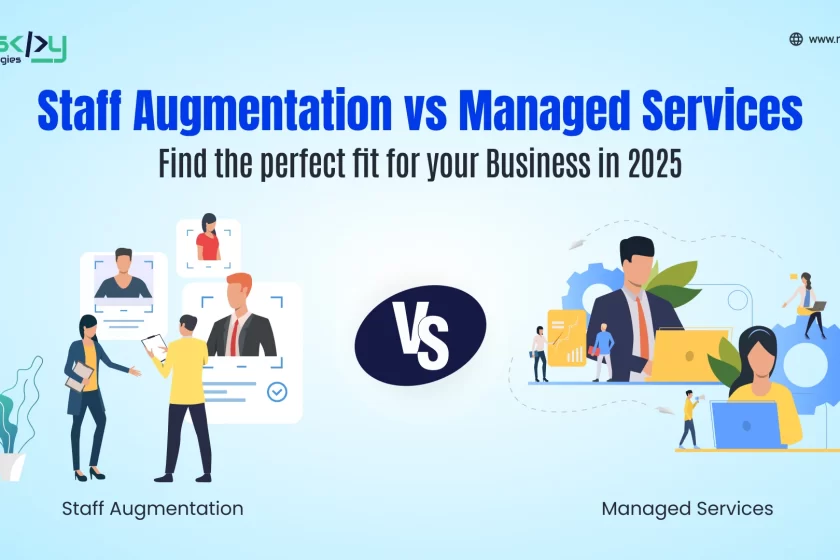
Let’s face it – choosing the appropriate model for your business is not as easy as taking a shot in the dark. Rather, it’s more of an educated guess. The digital world is filled with millions of choices, and a single one can practically determine the success of your app. And when this path forks between staff augmentation vs managed services, without sufficient knowledge, making a clear cut decision can be arduous.
If you’re here, you’re probably weighing the pros and cons of staff augmentation vs managed services, wondering which one best suits you and your app. You might be in search of options for IT staff augmentation, UI/UX design, or even cross platform mobile application development. In this blog, as a mobile app development firm upholding the idea of radical concepts like these, we shall delve deeper into the differences between staff augmentation and managed services, so that we have a clear differential of which strategy suits which business.
WHAT IS STAFF AUGMENTATION?
Let’s say you have a firm that consists of an already existing in-house team. Your team is tasked with a project that requires a complete tech stack – interactive design, cross platform mobile application development, website design, frontend and backend development. Your employees might check mark some of these skills but not all. In a project that requires multiple skill sets and areas of technical expertise, your in-house team might just not be as equipped with every skill as the project demands. In times like these, it’s important to scale your team up and to hire external help.
However, you do not wish to hire full-time employees, which could be for various reasons such as longer delays in hiring and cost factors. Such situations necessitate the need to incorporate staff augmentation into the workspace. It’s almost akin to a large pool of global talent fit into one company for a temporary period of time until the task or project is complete. And the best part is that it’s an extended development team, all under your direct purview. Staff augmentation vs managed services – does it really matter? We shall analyze the benefits of staff augmentation and then delve further into managed services as a whole.
BENEFITS OF STAFF AUGMENTATION
1. Flexible IT staffing
Need five developers this month and only two next month? No problem. Flexible IT staffing is at the heart of staff augmentation services. You get the chance to scale your team up and down depending on the needs and demands of businesses and project workload and deadlines. As we shall see later in better detail, when comparing staff augmentation vs managed services, the latter often locks you into longer contracts and predefined scopes, which might not be suitable for ever-changing business needs and goals.
2. Cost-Effective
One of the key reasons businesses in the USA and beyond prefer IT staff augmentation is because of how cost-cutting it is. No overhead costs, no benefits, no office space. You only pay for the expertise and services you get and when you get them. When you compare this to the traditional hiring model or even an application development company in USA, you’d realize how the concept of augmentation helps startups and small businesses to do more with less, without any compromise.
3. Fast Onboarding
We know – the trials and tribulations of having to consistently keep hiring full-time employees are just taxing. Plus the time it takes to post job ads, screen profiles, interview candidates, and onboard them is just too much to handle. With IT staff augmentation, you avoid the lengthy process of onboarding and employ skilled talent faster and more efficiently. You could literally hire remote developers any time you need. Thus, staff augmentation services lets you avoid the long-term commitment of traditional hiring.
4. Complete Control
Staff augmentation vs managed services – this comparison can be made in terms of control as well. Unlike the latter, staff augmentation maintains project leadership roles within the in-house team. Your project manager, your timelines, your standards – all controlled internally. This is particularly of use when your business wants to keep control while still leveraging the power of IT outsourcing. The staff augmentation vs managed services debate often comes down to this – do you want control (staff augmentation services) or convenience (managed services).
5. Specialized Skills At Your Disposal
When you work with a staff augmentation company, you get professionals with niche and specialized talent at your disposal – right from services like UI/UX design services, interactive design, or even custom app development. Since they are well-equipped with the necessary skills right at the start, there’s no need to train them. They come ready to contribute, whether you’re designing the next big mobile app or fine-tuning your user interface design.
6. Access to Global Talent
Working with a reliable staff augmentation company literally implies that you’re not restricted to localized talent. You basically access a global talent pool, including highly experienced UI UX design agency professionals, UX design agencies, and developers who have worked with the top app development companies globally. Need someone who can deliver user experience best practices or cross platform mobile application development? The world is your talent pool with staff augmentation services.
7. Better Alignment with Business Goals
When you compare staff augmentation vs managed services, the former gives one more alignment with your long-term strategy. It’s important to note that your augmented staff becomes part of your team culture, integrating with goals and close working with in-house staff. So, whether you’re building mobile apps for startups, launching an MVP, or improving customer satisfaction through better UX design, your journey is supported with augmentation.

WHAT’S STAFF AUGMENTATION IDEAL FOR?
This concept is useful when your in-house team is stretched too thin, and you need someone quick, fast, and for the time being. It’s not about replacing your team with new people doing new tasks – it’s about creating an extended development team, with a strengthened work ethic to meet goals faster, smarter, and more affordably. Let’s now dive into some scenarios where staff augmentation services can be ideal.
1. Let’s say the workload just keeps rising, but what’s worse is that your deadline for submission is nearing closer and closer. Based on this surge demand, you need to upscale and employ top-tier talent at the same time. IT staff augmentation helps you do that. It’s useful for:
➤ Mobile apps for U.S startups trying to meet investor timelines.
➤ Application development companies that need sudden talent for a client project.
➤ Agencies looking to hire remote developers for quick and efficient work.
2. Not every job role is the same. Some require pinpoint expertise. With augmentation at your fingertips, you can fill skill gaps for:
➤ Businesses seeking UI UX design services without hiring a full UI UX design agency.
➤ U.S firms requiring cross platform mobile application development expertise.
➤ Teams developing an MVP and needing help with a functional prototype that’s a hit with users.
3. Workload is not always the same. Sometimes you need help, sometimes you don’t. This concept is perfect for:
➤ A mobile app development firm working on seasonal or one-offs client apps.
➤ A web design company in America launching microsites.
➤ A US-based app development company wishing to test new side projects without burdening the rest of the team.
4. Staff augmentation is great for budget-conscious innovation. This is especially important for:
➤ App development for small businesses.
➤ Entrepreneurs launching on-demand app solutions world-wide.
➤ Local firms who want the quality of top app development companies without hiked prices.
MANAGED SERVICES – WHAT’S THAT?
This is significantly different from what we just read about augmentation. In managed services, you do not possess an in-house team. You basically outsource your entire work to an external company that takes control over the entire project at hand. If a job entails, say, a number of things like custom app development, managing cloud infrastructure, project planning, execution, support, and maintenance, it can all be covered with managed services without any hassle. In the debate between staff augmentation vs managed services, this model is ideal for companies that want outcomes, not just extra hands. But ever wondered why it’s called ‘managed’? It’s because you’re not managing every detail. This includes:
• Defining project scope
• Assembling the team
• Leading the project timeline
• Quality assurance and user testing
• End product delivery
BENEFITS OF MANAGED SERVICES
Here’s why managed services shine, especially in the staff augmentation vs managed services comparison:
1. End-to-End Project Ownership
In managed services, the outsourced team handles everything from start to finish. That’s perfect when:
➤ You lack in-house technical leadership.
➤ You don’t want to manage day-to-day development.
2. Full Stack Skill Access
Managed service providers often come with a full package – developers, designers, project managers, DevOps, and QA teams. That’s great for:
➤ App development for small businesses in USA with a small budget but requiring a full team.
➤ Startups looking for UI UX design services plus development and maintenance in one go.
➤ E-commerce firms that need mobile apps built fast.
3. Faster Time-to-Market
Managed services are built for speed. They follow proven workflows that are agile, prototype-first, and uphold user experience best practices. And if you’re aiming for high visual appeal, many managed teams include members from UX design agencies and UI design companies, giving your product a polished look from day one.
4. Predictable Budgeting
In IT outsourcing, especially with managed services, you usually pay a fixed price for a defined scope. This is a promising approach for government contractors, enterprises, and product-based businesses with stable, defined roadmaps. From mobile application development in USA to complete platform redesigns, between staff augmentation vs managed services, the latter makes budgeting really easy.
5. Maintenance and Support
Launching isn’t the only thing to think about. What’s important is what follows suit such as updates, bug fixes, server monitoring, and sometimes even rebranding. With managed services, post launch support and maintenance becomes a breeze. It helps monitor performance, improve based on user feedback, handle crashes, and downtime.

STAFF AUGMENTATION VS MANAGED SERVICES – WHICH ONE IS BETTER?
Let’s break this down. There’s no one-size-fits-all winner here. Between staff augmentation vs managed services, the better model depends solely and entirely on your business goals, your in-house capabilities, and how hands-on you want to be.
If you:
1. Want to keep full control, then staff augmentation is for you. If you don’t mind not being the boss of the project or the team and prefer not micromanaging or assembling your own team, then managed services is for you.
2. Want to hire remote developers on a temporary basis without the hassle of full-time hiring, then an extended development team is better for you. If you’re looking for complete UI/UX design, dev, launching, and post launch support, then managed services is the way to go.
3. Scaling up and down anytime you want is better suited for augmentation purposes.
4. Employ managed services if you want consistent timelines, budgets, and accountability.
CONCLUSION: STAFF AUGMENTATION VS MANAGED SERVICES
In the battle of staff augmentation vs managed services, the winner is:
➤ The one that aligns with your current business goals and stage.
➤ The one that matches your internal capabilities.
➤ The one that saves you time, money, and stress.
In short, if you already have a team and just need to optimize through extension and want control, go for staff augmentation. If you need a team from scratch and prefer IT outsourcing without control over projects, then trudge down the path of managed services.Whatever the dilemma with staff augmentation vs managed services may be, Naskay Technologies will bring you the change you always wanted to see. Contact us now to get started!

FAQs
1. If I choose staff augmentation, can I still control the design process of my app’s UI/UX?
Absolutely, that’s what IT staff augmentation does. It basically allows you to extend your team while controlling the workflow. In the battle between staff augmentation vs managed services, the former takes the title in offering full monopoly over the working environment and project.
2. I run a local business in the U.S. Do I really need cross platform mobile application development?
If your audience uses both iOS and Android, then yes, you do need cross platform mobile application development. And with mobile application development in USA rising fast, it’s the most efficient way to compete.
3. What’s the hidden cost about managed services that one should know about?
While managed services seem pricier on the outside, they can actually save you a lot of money by avoiding project delays, tech debt, and scope creep.
4. Can I switch from staff augmentation to managed services (comparing staff augmentation vs managed services) halfway through a project?
Yes, and we’ve helped ample people do that. Some start with flexible IT staffing and then move to full management projects. It’s a natural shift, especially for mobile apps for U.S startups that evolve rapidly.
Choose the right model and scale your business with confidence — let’s build your ideal tech team together!