Blockchain, a digital shield,
A chain of blocks where code is sealed.
Across networks where trust takes form,
To guard your data from every storm.
The healthcare sphere is a constantly evolving sector, where services are becoming more digital each day. Each leap has represented significant milestones technology has made in healthcare with the popularity of wearable health trackers to telemedicine. However, a pressing challenge lingers in the minds of many – what about the sensitive patient data accessed through healthcare apps? Say hello to ‘Blockchain’, your very own digital shield.
You need information to be safe, accessible, and tamper-proof, and with digital advancement, healthcare cybersecurity is a must. Blockchain has established its place as a cornerstone beyond just cryptocurrency; it has extended its uses and advantages to healthcare and safe patient information handling. It’s ingrained the very essence of decentralization in the tech world by giving patients more control over their health information, all while reducing the risk of data breaches, hacks, and fraud. Thus, using healthcare apps and trusting them with your information has become safer with such active steps to secure patient data.
In this guide, we break down how blockchain in healthcare is reshaping lives, how it works, and why it matters – not just from the tech point of view but for people all around the world. As a mobile app development firm, we at Naskay Technologies believe that security in the app world is a non-negotiable right. Hence, this blog aims to explain this importance in a way even a layman would understand. Let’s dive in.
DEMYSTIFYING BLOCKCHAIN: THE DECENTRALIZED POWER
Time for an analogy to make things easier. Imagine there’s a notebook that has been duplicated millions of times across a network of computers. Every transaction that occurs is recorded in every copy of the notebook, just like a log or an updated passbook. This means that whenever there is any change, then it’s updated across all versions of the notebook on each computer. In addition, any suspicious activity can be tracked. Such decentralized nature makes it nearly impossible for hackers to alter any record without virtually changing every copy, something that is unachievable.
This is the basis for blockchain. It’s a decentralized ledger that records transactions like a log over multiple computers. This ensures that decentralized medical records cannot be altered, ensuring a secure and transparent system.
THE PARADIGM SHIFT OF BLOCKCHAIN IN HEALTHCARE
Just a few years ago, healthcare data breaches were commonplace. That was when traditional healthcare data systems were centralized. This basically translated to the fact that a single access point called server contained all the sensitive information. All it could take for a security breach to occur was a malicious hack, potentially risking the leaking of every patient’s confidential details.
Over time, continual digitization led to the development of better security mechanisms to prevent such risks in the real world. This in turn contributed to more robust defences evolving in various sectors, including healthcare. Blockchain soon became more than just a buzzword; it began displaying real results that made people trust in it. As opposed to centralized data collection systems, this technology works on a decentralized mechanism.
Data is stored across a network of nodes, making it nearly impossible to compromise all at once. In case someone tries to tamper with data from a specific node, the other servers would reject it, and this suspicious activity would get easily detected. In addition, it allows data to be stored consistently across servers, making the possibility of change by any healthcare professional or miscommunication absolutely impossible.
Thus, the paradigm shift of blockchain in healthcare is attributed to trust in the system, where patients know their data is in safe hands. Additionally, providers can pinpoint any unauthorized access to patient data and the reason behind it. In the end, such a system empowers the patient – the power of medical history shifts from institutions to individuals.
| DID YOU KNOW? According to IBM, around 83% of healthcare executives view blockchain as a way to improve clinical trial management, patient records security, and supply chain transparency. |
| DID YOU KNOW? Healthcare fraud costs the U.S over $68 billion annually. Blockchain-based billing could reduce fraud by 30-50%, according to a McKinsey report. |
ADVANTAGES OF BLOCKCHAIN TECHNOLOGY
The term ‘Blockchain’ may sound very familiar, especially in the world of cryptocurrencies. However, it’s more than that. It’s the core of healthcare cybersecurity. It’s not just about Bitcoin; it’s about secure patient records and decentralized medical records. Let’s look at how blockchain in healthcare is paving the way to how healthcare mobile apps are becoming more robust and reliable.
1. Next-Level Data Security
Data breaches are an ever-present threat. As scary as it sounds, that’s the reality with increasing digitization and access to patient data in databases. Blockchain enhances the security game through:
◉ End-to-end encryption,
◉ Decentralized nature, and
◉ Immutability (data cannot be or deleted without a trace).
2. Power to the Patient
Blockchain provides power to the patient. Now, one can access and revoke access to data with just a single tap. For example, an ailing patient can use their blockchain-enabled app to instantly share lab results with multiple specialists in real-time. This proves that patients aren’t just handing out their private information blindly; they are in full control of its usage.
3. Stores Tamper-Proof Medical Records
Secure patient data is a must. And it’s important for medical records to be tamper-proof. It’s extremely vital to remember that they are more than just files; they’re lifelines. One mistake in documentation could be fatal. However, blockchain counteracts this with added layers of protection such as:
◉ Time-stamping
◉ Digital signatures
◉ Immutability
This makes it close to impossible for anyone to forge or delete records as everything is stored with full confidence and integrity.
4. Transparent Supply Chains
Pharma supply chains could lead to the possibility of fake or substandard drugs slipping through. Blockchain in healthcare helps maintain complete traceability from the starting point (factory) to the end point (pharmacy). It ensures that transit time is smooth, without any tampering. Plus drug authenticity is verified through app scans. This way, the legitimacy of medication is monitored and constantly reassured.
5. Enhanced Healthcare Cybersecurity
Imagine if there is a point of failure in a centralized healthcare system. Every connected computer fails. Blockchain’s decentralized nature allows for multiple nodes to exist at a single time. In case a point of failure occurs, then such a distribution of data eliminates such risks, leading to more robust solutions against cyber threats.

THE ROLE OF UI/UX IN BLOCKCHAIN-ENABLED HEALTHCARE APPS
Blockchain acts as a backbone for secure data management, but it’s the user interface and user experience design that ensures complete user friendliness and accessibility. Hence, it’s basically a well-designed app that often connects complex technology and everyday users. At Naskay, we specialize in:
◉ UI UX Design Services: These involve crafting intuitive interfaces that simplify blockchain functionalities and make them understandable.
◉ Prototyping: We believe in trying before releasing. Our interactive prototypes help visualize the app’s flow and functionality.
◉ Customer Satisfaction: A prime goal is to prioritize the customer. This directly corresponds to enhanced user experience.
◉ Interface Design: Responsive and dynamic interfaces are key towards increasing engagement for users.
In summary, our expertise as a UI UX design agency ensures that your healthcare app is not only user-centric but also secure.
HOW U.S BASED HEALTHCARE STARTUPS ARE EMBRACING BLOCKCHAIN TECHNOLOGY
Healthcare startups are progressively acknowledging the power of blockchain all across the United States. With rising concerns around healthcare cybersecurity, especially for mobile apps handling secure patient data, U.S.-based app development companies are integrating decentralized medical records to protect sensitive information.
As a leading healthcare mobile app development company in the USA, Naskay Technologies helps startups integrate blockchain with intelligent, secure app architectures, built with both HIPAA compliance and seamless user interface design in mind.
CROSS-PLATFORM BLOCKCHAIN APP DEVELOPMENT
Healthcare apps need to be versatile. They need to be capable of running flawlessly across both Android and iOS. That’s where our cross-platform mobile app development company comes in. Using frameworks such as Flutter and React Native, we provide custom app development without the need to build two separate codebases. This is of great importance, especially for healthcare app development services, where reaching a wide patient base, regardless of the device used, is an immense priority. The underlying blockchain in healthcare ensures that users can access decentralized medical records and health services on any device, any time. Thus, mobile app design and state-of-the-art blockchain security must go together with cross platform compatibility.
FUTURE TRENDS OF BLOCKCHAIN IN THE HEALTHCARE WORLD
Let’s now analyze some of the future trends of blockchain that we could expect being implemented on a continual large scale.
1. Integration with IoT
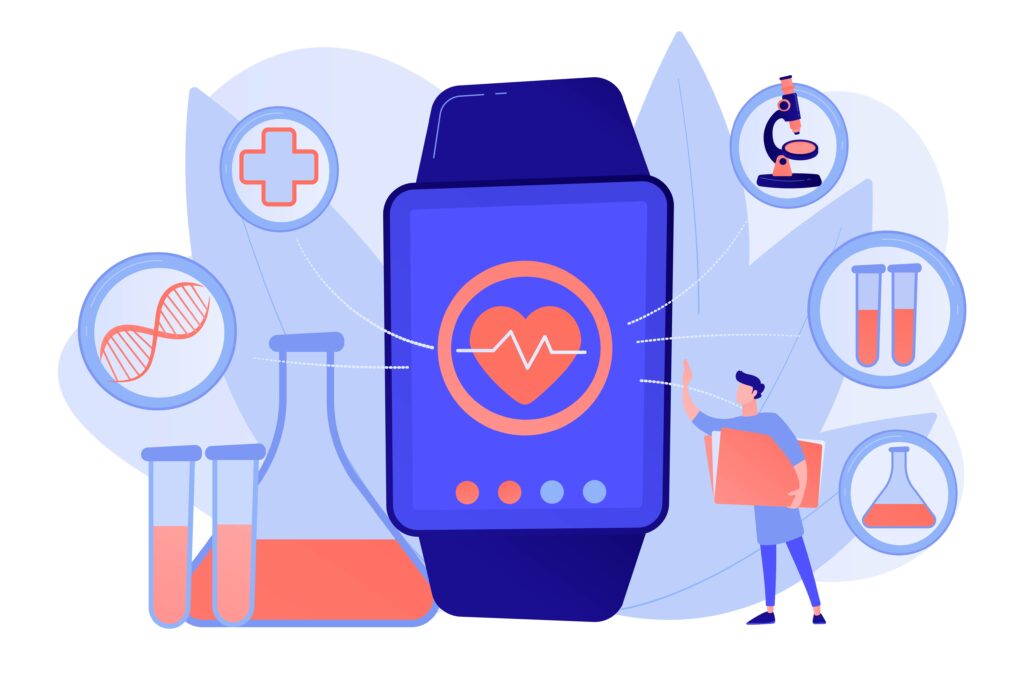
The future of healthcare is built on the foundations of synergy and not just on one technology. When decentralization is integrated with AI diagnostics and IoT wearable devices, new doors for next-gen healthcare capabilities are opened up. Imagine a mobile app that collects your health metrics like heart rate, oxygen saturations, and blood pressure readings from a wearable, analyzes it with AI, and stores it securely using blockchain.
2. Reliable Emergency Response
Let’s say a patient is unconscious in an ER far from home. With traditional systems, doctors may struggle to peruse their health history. However, with decentralized medical records, verified patient data can be instantly accessed without the risk of a single data breach. Our mobile application development focuses on the smooth integration of such concepts into mobile apps – even in emergencies. With reliable partnering with a US-based app development company like Naskay, you ensure patients receive accurate, timely care – no matter where they are.
3. The Saviour of Healthcare Cybersecurity in the U.S
Did you know that according to the HIPAA Journal, the U.S saw more than 700 healthcare data breaches in 2023, exposing over 133 million records. As a healthcare cybersecurity solution, blockchain steps in and prevents this from happening. It is expected to surge to growing levels of popularity in healthcare because data stays nearly immutable, decentralized, and impossible to tamper with.
FROM CONCEPT TO CODE: OUR SOLUTION TO YOUR RESCUE
At Naskay, we don’t just build apps from scratch; we prioritize security as a top-notch concern to account for. As a top-rated app development company, we specialize in designing apps that merge blockchain with intuitive UX design. And where does our process in curating interactive design stem from? Yes, it’s when our team builds a wireframe and prototype to ensure customer satisfaction. In addition, our QA experts ensure your app is HIPAA-compliant and flawless. So, whether you need app development for small businesses or enterprise-grade platforms, our U.S-focused services deliver end-to-end solutions tailored for healthcare innovation.
And the best part about us? We create lasting impressions and experiences that build trust. Think of us not as mere developers but rather partners in your healthcare journey. Our mission lies in helping U.S-based startups and healthcare providers in designing mobile apps that are secure, beautiful, and future-ready. Our advice going ahead – choose a UI UX design agency that understands the unique challenges of the healthcare sector and the limitless potential of blockchain.
CONCLUSION
To conclude, blockchain is no more a futuristic concept. It’s in the present, rebuilding the digital infrastructure of healthcare. In essence, it’s driving a true paradigm shift. So, want to build a blockchain-secured healthcare app that users will love? With our blend of UI UX design services, deep understanding of user experience best practices, and robust development capabilities, we deliver apps that are secure, smart, and satisfying to use. Explore our services, and let’s get started. It’s time to innovate and secure with Naskay and build an experience that users would simply love.
FAQs
1. Isn’t blockchain just for cryptocurrencies? Why should I care if I’m building a healthcare app?
It’s a tamper-proof digital ledger that shares its data across multiple systems, perfect for handling secure patient data. It protects, decentralizes, and traces data with pinpoint accuracy.
2. How does blockchain improve app security compared to traditional databases?
Since traditional systems are centralized, a single point of failure could potentially lead to breaches. Blockchain uses a decentralized network, making it almost impossible for hackers to alter or forge medical records.
3. How does it help with compliance with US healthcare regulations like HIPAA?
Through transparent logs, secure patient data sharing, and controlled access, blockchain helps healthcare mobile apps stay compliant with HIPAA and other privacy regulations.
4. What if I just want a prototype first before committing to full development?
You can! We offer swift, effective prototyping services so you can test your app idea, complete with interactive design and key features – before going all in.
Trust is care. Strengthen patient data security with blockchain-enabled mobile solutions – built for the future.